
Get better at product development, one meeting at a time.
Lyt sits in, whether it is a steering group meeting, a customer meeting or a user interview, and tells you what you could do better.

7 days free, then from DKK 99 a month.
Nobody tells you what you did well, and what you could do better.
Lyt does.
Hit record before the meeting.
No prep.

Concrete feedback, quoted from your own meeting.
The window is a demo of the app, click around in it.
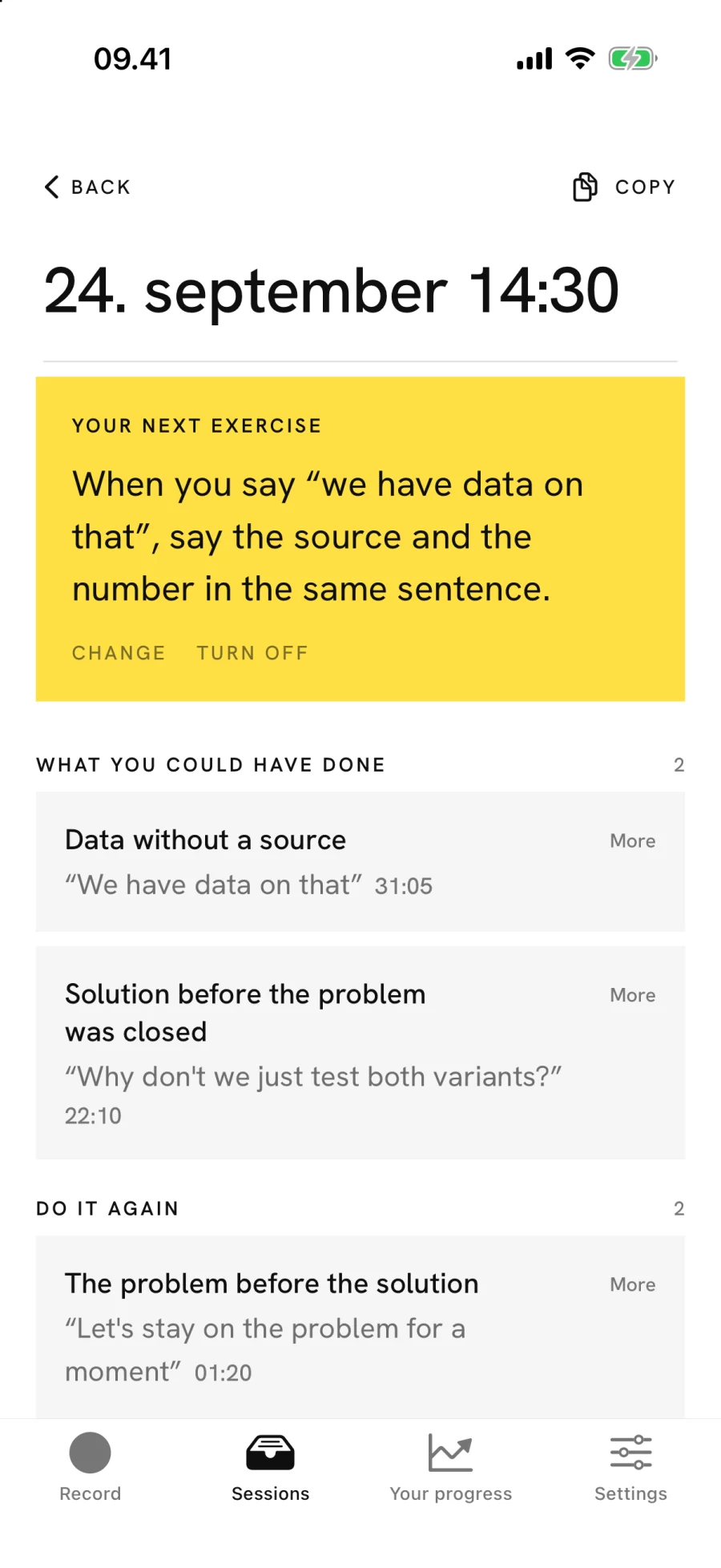
This is what the feedback looks like on your iPhone.

Discovery meeting on the onboarding flow

Your exercise
Half way. You said the source twice, lost it the third time.
Different from last time: back then you never mentioned a number. Today “12 tickets” [08:40] came up twice. The third time [31:05] it became “we have data on that”, and that claim carried the rest of the decision.
When you say “we have data on that”, then say the source and the number in the same sentence.
3rd meeting with it. Replaces “Open with the problem, not the solution”, which you kept for 4 meetings. ChangeWrite your ownTurn offWhat you could have done2
Do it again2problem before solution · let the designer conclude
Your focus2Discovery · Leadership
Next time2
Which 12 tickets, and what exactly did the three interviews say?
What would make you drop both variants?
Teresa Torres separates what you know from what you assume. “We have data on that” belongs in the second column until the source is said out loud.

Summarywhat the meeting was about
45 minutes on the onboarding flow with a designer. You landed on testing two variants, and you made the call on the order.
Transcript38 turns · Copy
YouLet's stay on the problem for a moment. What do users run into before they give up?
Speaker BThey drop off at step two. That's where they have to pick a department.
YouYes, and we have data on that. So I think we test two variants of that step.
Sprint review with the business
Your exercise
Didn't come up today. The practice made no sense in a review without data claims.
First measurement. You mentioned data once, without a source, so the practice hasn't been tested yet.
When you say “we have data on that”, then say the source and the number in the same sentence.
New after the last meeting. ChangeWrite your ownTurn offWhat you could have done2
Do it again2the team demoed it themselves · the deadline question got an answer
Your focus2Delivery · Leadership
Next time2
What was cut to hit the deadline, and who decided?
Which sprint goal would have turned the demo into evidence?
Marty Cagan: a sprint review is evidence of progress toward an outcome, not a showcase of output.
Summarywhat the meeting was about
A 30-minute review with the team and two people from the business. Four things were demonstrated, and the deadline came up at the end.
Transcript27 turns · Copy
YouLet's run the review. Jonas, will you start with search?
Speaker CHow are we looking on the deadline, now that we've spent two weeks on this?
YouWe'll make it. There's still some room in the last sprint.
Sessions
2 meetings with feedback. Latest: 27 May, 14.30.
Your progress
2 meetings with a verdict
B2B SaaS, team of six, I'm new as a PM.
on iPhone, Mac, and in your inbox
Built on
I have boiled everything I know about product leadership, theory and practice, into the app.
- The theory that matters in product leadership. Ten competencies distilled from decades of product leadership literature.
- The context you are in. The company, the team and the type of meeting.
- Your role. Whether you are a head of product, a PO, a UX designer or a manager.
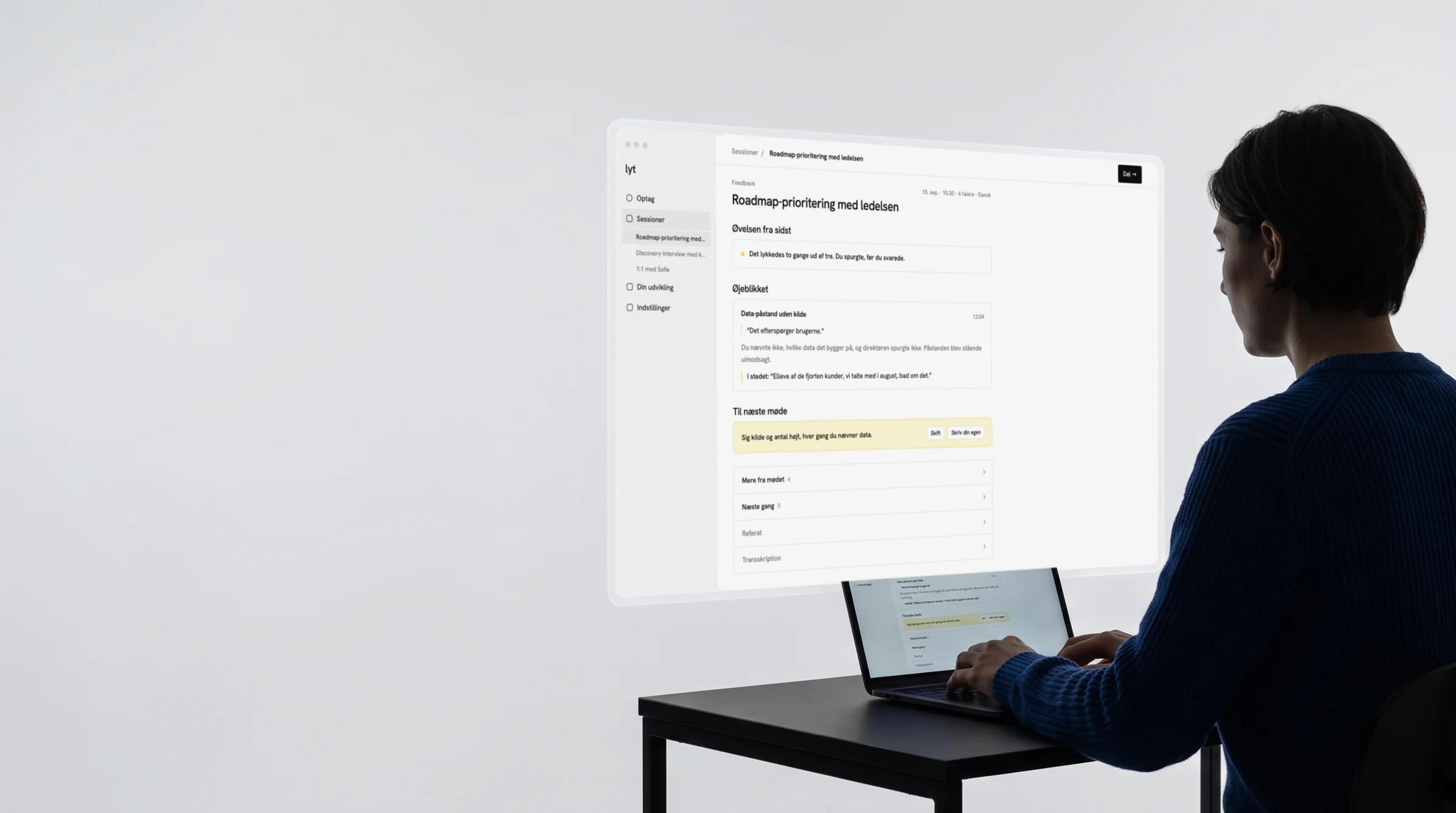
Keep your note-taker. Lyt is the coach on top.
You do not have to switch tools. Paste the transcript or import the file, and Lyt coaches on top of it.
 Teams
Teams Zoom
Zoom Google Meet
 Fireflies
 Granola
 Fathom
Built for meetings that must not leak.
Meeting recordings are some of the most confidential material you have. That is why the data flow is as short as it can possibly be.
- The audio is processed in the EU. Transcription runs in Dublin, and the server never stores the audio. Both the audio file and the transcript are deleted at the vendor the moment Lyt has fetched the result.
- Your meetings train no AI models. Not a promise, but the vendors' written policy: EU-processed audio is exempt from training, and the coach models do not train on API content.
- Everything lives on your device. Summaries sit locally, as files you own. On our side the report only exists while it is being built, and disappears shortly after your device has picked it up. There is no archive to log into.
- No account, no tracking. The app does not know who you are. It knows an anonymous device id, nothing else. There is no analytics to switch off.
Questions and answers
Can't find the answer? We'll cover it in 20 minutes.
Book a demoWho is Lyt for?
For people who work in product and spend a lot of time in meetings: product managers, product owners, UX and product designers, Heads of Product and other product leaders. You tell Lyt about your role and pick up to three focus areas, so the feedback fits your work.
What do I get after a meeting?
Three things: how it went with the exercise from last time, one moment from the meeting with what you said and what you could have said instead, and one exercise for your next meeting. Summary, transcript and more moments are folded away below.
What is Lyt built on?
Coaching theory and research on what makes feedback work. That is why you get what you need after a meeting: concrete moments from your own meeting and one thing to practise. Your progress shows, meeting by meeting, whether the exercise worked.
Which meetings does it work for?
Both in-person and video meetings. On Mac and Windows, Lyt also records the computer's audio, so both sides of a meeting in Teams, Zoom or Google Meet are captured. On iPhone, Lyt records the room you are in. A meeting can last up to three hours.
Does a bot join the meeting?
No. Lyt records on your own device, so no extra participant shows up in the meeting.
Do I have to replace my note-taking tool?
No. Lyt is the coach on top. You can paste or import a transcript from Teams, Zoom, Google Meet, Fireflies, Granola or Fathom and get feedback on it.
Do I need my own AI key?
Only if you want one. With your own key, the coaching runs on your own agreement with the AI provider. With Lyt Plus the AI is included, and there is nothing to set up.
What does it cost?
The first 7 days are free. After that DKK 99 a month or DKK 899 a year with your own AI key, or DKK 149 a month or DKK 1,499 a year with Lyt Plus, where the AI is included.
Which languages and devices?
Danish and English, on iPhone, Mac and Windows. You choose the meeting language in the app, and the feedback comes in the same language.
A coach costs DKK 3,000 an hour. Lyt costs from DKK 99 a month.
7 days free.
