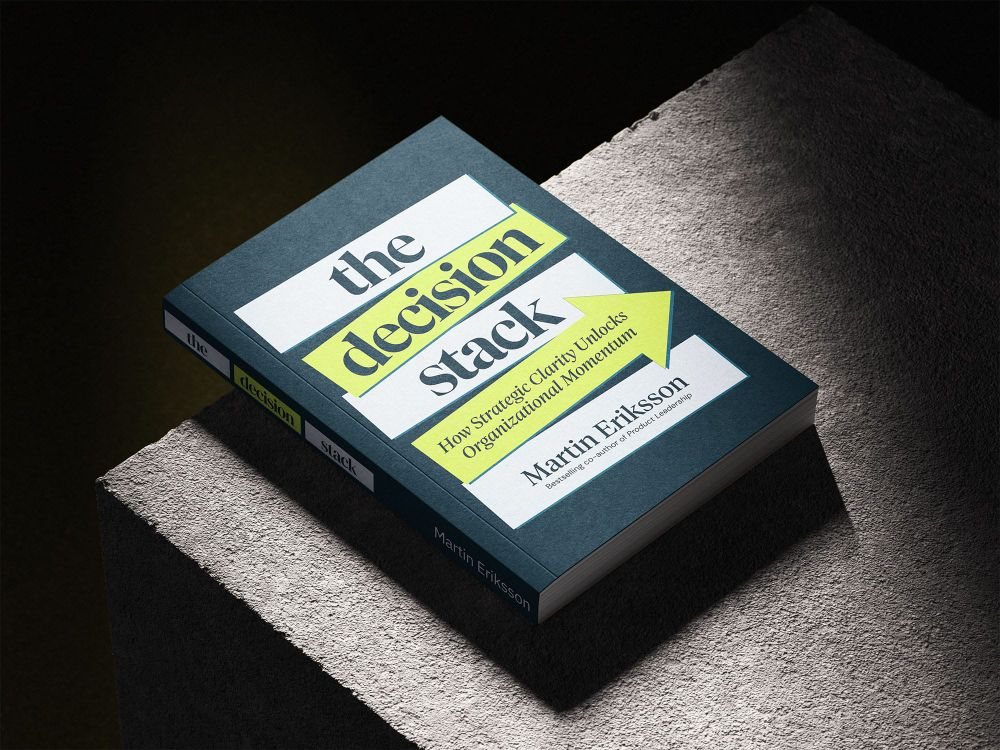
I’m reading The Decision Stack by Martin Eriksson, co-founder of Mind the Product. The book came out this year and builds on a model he has talked about since 2021: an organisation’s decisions fit together in a stack, from the vision at the top to the small choices a team makes on a Tuesday afternoon.
Eriksson starts in a refreshing place. Most of the organisations he works with have piles of ideas, he writes. The problem is that the layers live separate lives. The vision hangs on a poster, the strategy sits in a slide deck nobody opens, and the OKRs live in a third tool.
It’s the same connection that breaks when an organisation starts using AI. So while reading, I’ve been asking myself a practical question: what can AI do in each layer of the stack?
The principles sit at the bottom. In the first version of the model they were layer number two, but in the book and on the book’s website they are the foundation, because they make it possible to take decisions at the edges of the organisation without anyone having to ask for permission.
Experiments belong under opportunities, and Eriksson applies the same thinking to strategy: it’s a hypothesis that should be tested “as quickly, cheaply, and low-risk as possible”.
Under each layer there is a prompt you can fill with your own text and copy. What you write stays in your browser.
What Eriksson himself says about AI
Over the course of 2026, Eriksson has written a series of posts about AI and agents on the book’s website. His point is that AI amplifies what is already there. “The agent executes perfectly. It just executes the wrong things.” A fleet of agents working from unclear instructions scales the confusion at machine speed.
His advice is to make the stack honest before you scale it. He also describes how the organisations that do this well frame the question: they ask how AI can support their strategy, instead of asking what their AI strategy is.
He has a checklist that runs an AI initiative through all five layers. Type in an initiative you’re considering, and it appears in the questions.
- VisionDoes this serve where we're going?
- StrategyDoes this fit the choices we've made about where we play and how we win?
- ObjectivesDoes this move what matters right now?
- OpportunitiesDoes this solve the right problem?
- PrinciplesWhen this faces a dilemma, does it know which way to lean?
The checklist is for assessing an AI initiative. In each layer, AI can also help with the decisions themselves.
One rule for all five layers
Teresa Torres has written about how she uses AI to analyse customer interviews. She does her own synthesis first, then runs the same interviews through Claude and ChatGPT and compares. Her reasoning is simple: “When we lose our synthesis skill, we also lose the ability to evaluate the quality of AI synthesis.”
That rule applies to the whole stack. It’s the same idea behind asking for five versions when you design with AI: the first draft is a starting point.
Write the draft yourself. Use AI to find the holes in it.
It’s also how you get around the models’ habit of agreeing with the user. Ask whether your strategy is good, and you get a yes. Ask where it falls apart, and you get something you can use.
1. Vision and mission: test whether the vision can steer a decision
A vision has to be usable. If it has never made anyone say no to something, it’s a poster.
Give AI your vision and mission along with five decisions you’ve made in the past six months. Pick the ones that actually cost something: a customer you turned down, a feature you dropped, a hire.
Here is our vision and mission. Here are five decisions we made this year. Which of them would the vision have led us to, and which would it have stopped? If it can't tell them apart, say so.
The answer tells you whether the vision is written concretely enough to make a difference. The vision itself is written by the people who have to stand behind it, and it should be possible to say it out loud without wincing a little.
2. Strategy: find the choices you haven’t made
Eriksson defines strategy as “a coherent set of choices about what we’re going to do to achieve our vision”. He borrows Roger Martin and A.G. Lafley’s two questions: where do we play, and how do we win? And he adds: “Real strategy requires trade-offs.”
Strategy is the layer that is most often missing. Eriksson has an exercise for finding out: put five leaders in a room, have each of them write down the company’s strategy, and read the answers out loud.
This is where AI is a real help. Collect the five answers and ask for a comparison.
Here are five leaders' versions of our strategy, each written separately. Where do they agree? Where do they say different things without noticing? Which choices about where we play and how we win are missing entirely?
The next test is Richard Rumelt’s. In Good Strategy Bad Strategy he describes bad strategy as goals dressed up as strategy and fine words with no choices behind them. Give AI your strategy and ask it to mark every sentence that is a goal, a wish or filler, and every sentence that is a real trade-off. Many strategies consist only of the first kind.
Finally, you can ask AI to write the strategy your strongest competitor would choose if they did the opposite of you. It’s a quick way to see whether your choices are choices at all. If you want to see what competitors actually do, you can also have an agent onboard with them. I’ve written before about how I use Cowork to challenge my own product strategy.
3. Objectives: trace every goal back to a choice
Objectives translate the strategy into what matters this quarter. Eriksson writes that they should describe “outcomes, not outputs”. That also goes for what you ask AI for, as I wrote in What if your AI understood your outcome instead of your output? He also writes that OKRs are one format among several: “You don’t have to use OKRs, though if you do, it’s worth getting them right.”
AI can write OKRs. OKR consultant Sara Lobkovich notes dryly that the models write textbook OKRs that follow all the good advice. The hard part is elsewhere: getting a team to think in impact rather than activity, and knowing their capacity and maturity. A model can’t see that from its seat in the chat window.
So use AI to check the connections.
Here is our strategy, and here are our OKRs for the quarter. Which strategic choice does each objective serve? Which key results measure something we deliver, and which measure a change for the customer? Which objectives can't be traced back to the strategy?
An objective that can’t be traced back is what Eriksson calls disconnection. It’s also where most OKR efforts go wrong.
4. Opportunities and solutions: synthesise yourself first, then build to learn
In this layer, Eriksson points to Teresa Torres’ opportunity solution tree: each opportunity opens up several possible solutions, and you shouldn’t settle for the first one.
AI helps with two things here: analysing customer interviews and building the prototype.
When analysing customer interviews, Torres warns against the most common mistake, which is skipping a step: “They synthesize across their interviews before they’ve synthesized each interview separately.” Take one interview at a time. Write down the key opportunities yourself. Then ask AI to do the same, and see what each of you missed.
Here is a customer interview and the opportunities I found in it myself. Which ones did I miss, and where did I read more into it than the customer actually said? Quote the interview for each point.
Once every interview has been done this way, you can synthesise across them.
A prototype now takes an afternoon to build, so a customer can click around in it. It’s tempting to build the whole solution and show it off. I’ve written about that temptation in Faster development. Faster horses. Use the prototype instead to test the one assumption that brings the solution down if it’s wrong. Ask AI to list the assumptions behind the solution and rank them by how bad it is if they don’t hold. Build only what tests the top one.
Eriksson applies the same thinking to strategy. It’s a hypothesis too, and it can also be tested cheaply before you spend a year on it.
5. Principles: write them so an agent can use them
Principles are the layer most often missing altogether, Eriksson writes. They decide what you choose when two good things get in each other’s way. One format he uses is “even over”: job seekers even over recruiting companies, as the job site Monster put it. Or self-service even over personal support.
Try it yourself. Write two things you both want, and put one above the other.
Principles are also what an agent needs most. An agent that has to take a task from start to finish faces the same dilemmas as a team, and it has nobody to ask. Eriksson asks the question directly: does the agent know which way to lean?
I’ve tried this on this site. The instruction file that Claude works from is full of principles: the site has three surfaces and no fourth, yellow is used only as a highlight and never as a surface, and a new English page is better not built at all than built halfway. Every rule is there because something went wrong the first time. When they’re written down, they hold. When they only exist in my head, the model guesses.
Principles can be tested the same way.
Here are our principles. Here is a concrete situation from last week where two concerns pulled against each other. What would you choose based on the principles alone, and which principle decided it?
If AI lands somewhere other than you, the principle is too vague. Rewrite it until it gives the same answer as the people who wrote it. Then a new colleague and an agent can use it too.
This ties in with what I wrote in From inspiration to agentic product organisation: shared context is what lifts an organisation from 200 individuals with a subscription each to one way of working. The principles are a large part of that context. The rest of it is described in the playbook on AI product leadership.
The danger: skipping the thinking
There is a real risk in all of this. In June, BCG asked 70 senior executives about AI and skills. Nearly nine in ten said people trust AI output without stress-testing it. The skill the executives saw as most at risk was judgement and decision-making. It’s a small study of what leaders experience, and BCG sells consulting on the subject. But it matches Torres’ point: if you no longer do the work yourself, you can’t see when AI does it badly.
At its core, the Decision Stack is a series of choices that people have to make and stand behind. AI can make the choices sharper by finding contradictions, gaps and trade-offs you never got round to making. It can’t make them.
Use the time AI gives back
Eriksson has a post about what leaders should spend the time on that AI frees up. His answer is maintenance: updating the stack when the business changes, and going through it in your one-to-ones. Otherwise the time goes to producing more of the wrong thing, faster.
If you want to get started, start with the five-leaders exercise. It takes an hour, and AI can read through the answers in a couple of minutes. Whatever is missing in the comparison is the layer to work on first.
The book is The Decision Stack by Martin Eriksson. I’ll come back to it when I’ve finished it.